I'm almost done with college now, but seeing some underclassmen friends' admission results come out reopened my old college admissions scar again.
When I was in high school, Reddit stats comparisons, YouTube flexing videos, college counselors, and peers all seemed to imply the same thing: if you had more merit, you would get a better college admissions result.
By extension, that would mean colleges ranked higher by U.S. News should have classes with strictly stronger students than colleges ranked below them. So back then, the distribution of student merit across colleges looked something like this:
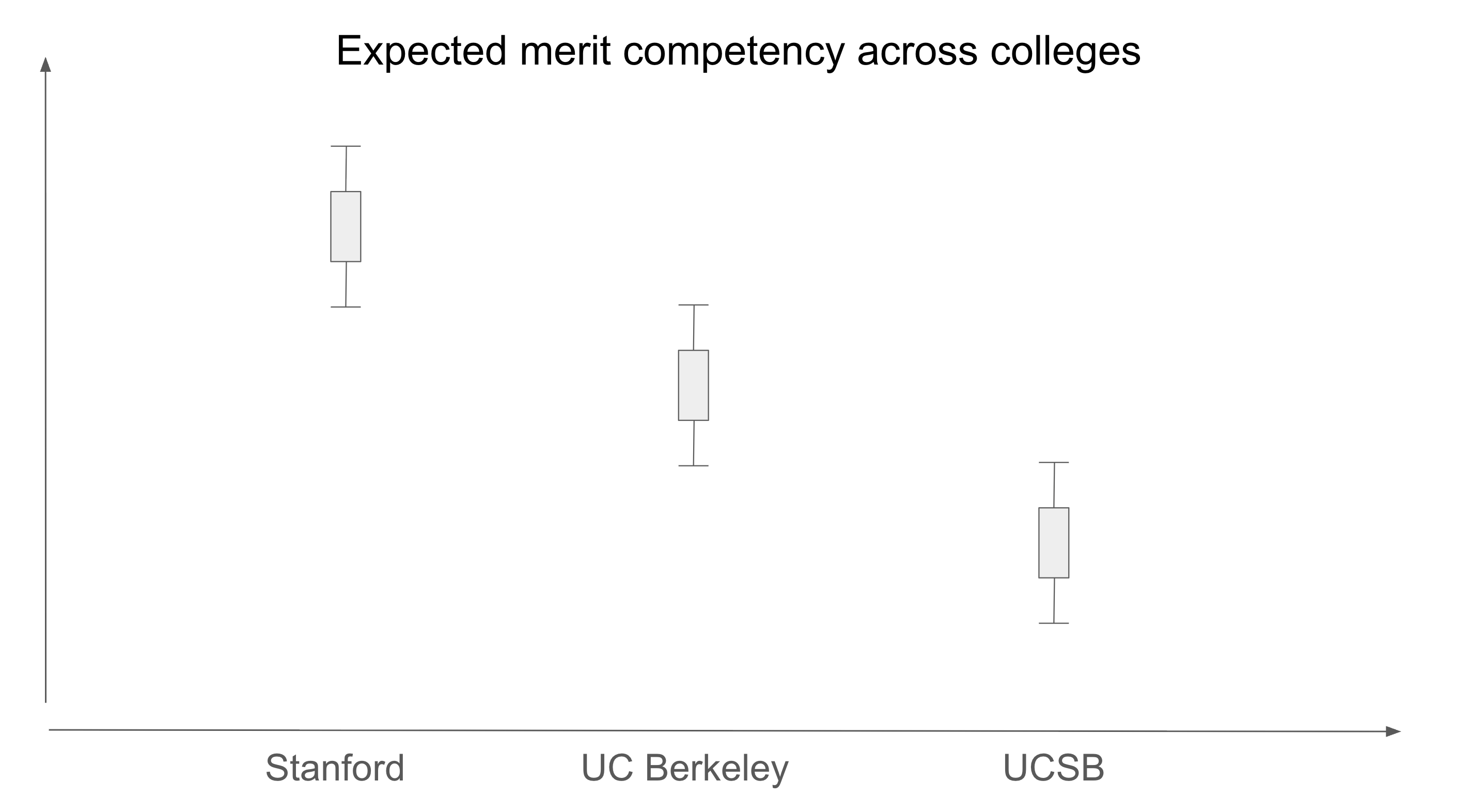
That was basically my mental model in high school. I thought students at higher ranked colleges had strictly higher merit than students at lower ranked colleges.
Then my own admissions results came out. Then I heard the stories of friends and acquaintances around me. That was enough to break that old model.
Now I believe two things:
- Stronger merit in a college applicant doesn't mean better college admission result
- The strongest students at a lower ranked college can have just as much merit, if not more, than many students at a higher ranked college
So now, my view of the distribution looks more like this:
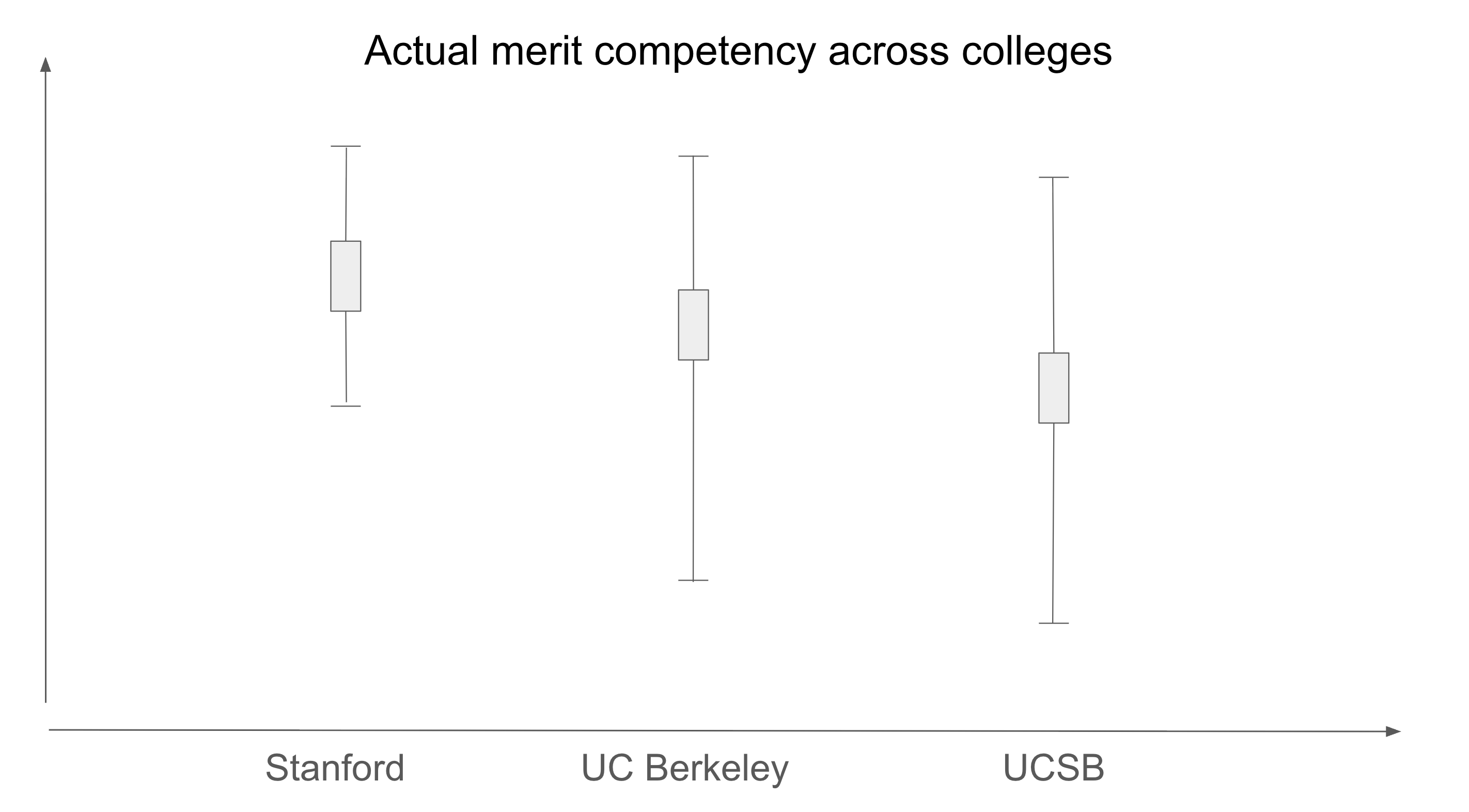
My new belief implies a couple things:
- Within the same college, the strongest students can be far above the median, and the weakest can be far below it
- Across colleges, the strongest students at a lower ranked school can be stronger than plenty of students at higher ranked schools, and sometimes nearly as strong as the very best there too
That variance still amazes me. It keeps reminding me how random college admissions can feel in practice. How on earth did some of these star players get turned away from the big-name colleges?
And by star players, I don't just mean pure olympiad grinder types. I also mean well-rounded applicants with strong extracurriculars, initiative, and leadership.
To make this concrete, here are a few cases that really killed my old high school belief of college admission meritocracy:
- A guy with USACO Gold and then Platinum: UC San Diego
- Several guys with 4x or more AIME math competition qualifications: UC Santa Cruz, UCSB, etc.
- A guy with USACO Platinum: UCSB
- A guy with IOI Camp: De Anza community college and then UCSD
- Several guys with super strong and genuine extracurriculars (no B.S. non-profit or anything) and leadership experience: UC Santa Cruz, UCSB
- A guy with top 100 math competition ranking from China: UCSB
- A guy with USAPHO and USAMO medals: UCSB
It is still crazy to me that people like these got turned away from the star-name colleges. Sure, many of these examples are from UCSB because that is where I go, so naturally that is the sample I know best. Still, it shocks me.
You can find people at places like Berkeley EECS or MIT who had much less math or CS depth in high school, while these guys, with far more obvious technical achievement, got rejected. That does not mean Berkeley or MIT admitted weak students. It means admissions outcomes are clearly not a clean sorting by raw ability.
So what is the takeaway here?
I still do not fully know. At this point, I do not even know what college admissions are really optimizing for anymore. Intellectual curiosity? Leadership? Personality fit? Institutional priorities?
The people listed above were not just competition medalists. Many of them were genuinely talented across the board too. They checked a lot of the boxes people associate with the ideal college admission applicant, and still ended up with outcomes that looked way below what Reddit stats post would predict.
One comforting fact, though, is that a bad admissions outcome did not stop these people. They seem to be doing very well afterward. In the same order:
- Became the best competitor on the UCSD ICPC team, scored top 2 in ICPC Southern California regionals in the past two years, placed top 25 in the North America Championship, and is now heading to Citadel Securities. He also got 7th place in picoCTF and top 200 in Putnam
- Interned at top companies, made Putnam top 250, and qualified for ICPC regionals
- Became the best competitor on the UCSB ICPC team and made it all the way to ICPC World Finals, beating teams from big-name schools like UC Berkeley, UCLA, and Harvard
- Made it to ICPC World Finals from De Anza College, and now, I think, is going to a quantitative finance firm
- Became a profitable entrepreneur at the age of 20
- Scored top 10 in the world on the Putnam and is considering transferring to MIT
- Scored top 5 in the world on the Putnam and had already transferred to MIT
Maybe that is the real comforting conclusion. College admissions can be noisy, unfair, and weirdly random, but over a longer time horizon, real ability still has room to show itself.
Or at least I hope so.